Posts

Harriman State Park Regional Rail Access

Image
  Map showing the location of Harriman State Park (merged for clarity with the smaller Bear Mountain State Park on its northeast side), and access routes from New York City (NYC) by regional rail. Major NYC-area rail transit hubs are abbreviated as follows: Grand Central Terminal (GC) , Penn Station New York (PEN) , Hoboken Terminal (HOB) , Secaucus Junction (SEC) , Harlem 125th St. Station (Harlem 125) . Service east of the Hudson River is on the Metro North Railroad's Hudson Line. Service West of the Hudson is on Metro North's Port Jervis Line. For details, see  https://www.mta.info/agency/metro-north-railroad . N.B. the two triangular symbols with Harriman and Bear Mountain State Parks indicate approximately the two most interesting hiking areas of the park, in the author's opinion.

Bear Mountain

Image
 A hobby of mine that I'd like to invite you to share with me is finding majesty in small places. To that end, in this post, I'd like to take Bear Mountain seriously as a mountain. Better known for its Octoberfest, ice rink, and capacious grilling areas, Bear Mountain State Park is also a great hiking destination. The mountain itself stands out from the surrounding Hudson Highlands as slightly steeper and more rugged, due to its granite bedrock. Like most of the Appalachian mountains, it has steep sides and a wide rounded top, but the summit has a good 180 degree view to the south, by virtue of a large smooth rounded outcrop of pink granite just below the tower and parking area. There are probably a few different routes up that would involve some challenging scrambles. One of the mountain's most striking features, whether viewed from a distance or encountered at close range, is a band of very steep bare ledges  across its southwest face. Visited in early March, these ledges...

King of Boredom on the Prairie: An Amateur Architectural Criticism of Madison, WI

For those of you who don't know, "King of Boredom" is a nickname given to me by a friend. To be clear, I take pride in this nickname. There is value in exploring certain sides and angles of boredom, even embracing them as a part of one's identity. I am not disparaging Madison, Wisconsin by calling it boring. The city has an identifiable visual aesthetic, which right away places it above many US places architecturally. Its character and sense of history convey a strong and confident message of boredom. A major theme is "dun" colored stone, a hue Merriam-Webster describes as " a slightly brownish dark gray". More modest buildings make use of similarly colored tan bricks. Equally characteristic are low horizontal lines. A 70's government office building with a concrete facade and long rows of black windows, or a modest low-rise garden apartment complex, fit with this style incredibly well. Anywhere else, these buildings would come off as mildly ug...

The Bronx River

 Living in the urban core of a sprawling metropolis, one develops passionate fantasies about abundant, clean, pristine nature, especially during the summer. New Yorkers have a habit of leaving the city during the summer, as their means allow. We do have nature in the city - huge rivers, beaches, forested parks, gardens, etc. - but not "abundant, clean, pristine" nature. An "urban hike" along the Bronx River, as a friend suggested, did not promise to fulfill my nature fantasy for a nice Sunday in June. The Bronx River barely registers as blue or green on a map amidst the street grid, other than in the Botanical Garden. But who am I to demand on-demand access to bountiful natural resources? Where I come from, suburban New Jersey, was almost as urbanized and environmentally degraded as New York City. The river through my neighborhood growing up, the east branch of the Rahway, was more like the Bronx River than a clear mountain stream. Fed from concrete culverts and sto...

A Hemlock Ravine in Pennsylvania

Image
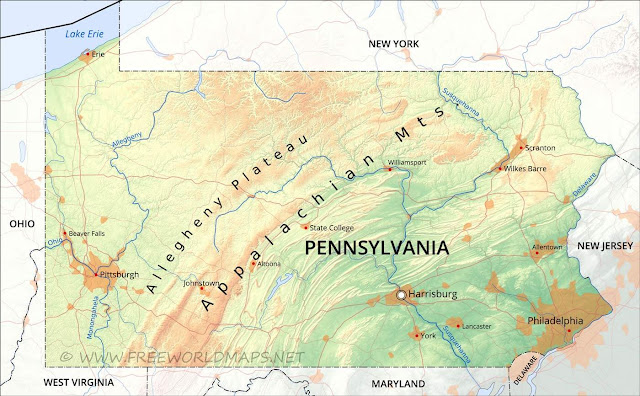
Pennsylvania is covered with great expanses of forested, semi-rugged terrain. There is ample subtle beauty here but not the drama or wow-factor that draws in crowds. I might not advise going too far out of your way to vacation in the woods of PA, but those who do spend time there are rewarded with a seemingly endless supply of scenic, off the beaten path places to enjoy nature. The steep-sided ravine of a cascading stream on the flank of Rising Mountain, one of the long flat-topped ridges that make up the Appalachian Ridge and Valley Provence, about 40 miles west of Harrisburg, is one of those opportunities. Designated the Hemlocks Natural Area of Tuscarora State Forest, it contains old growth forest estimated at 120 acres. Parts of the ravine are in hemlocks as advertised. The archetypal image of huge old gentle dark trees with a dense cover of ferns beneath them is unfortunately somewhat complicated by the destruction due to the the Hemlock Wooly Adelgid, an introduced pest, which ha...

Mt. Beacon

Mount Beacon is one of the best vantage points in the Hudson Highlands. Approach from the west and you can also get a fun rock scramble similar to nearby Breakneck Ridge on the way up. On a clear day, from the open rocky summit or the cabin of the fire tower, you'll see, going roughly counterclockwise, starting with the west: Schunnemunk Mountain directly opposite the Hudson River, formed into a wedge shape by whatever intersecting tectonic forces caused the Appalachian Mountain chain to bend at this spot. A birds-eye perspective on the Hudson Highlands : the river itself coming in and out of view between the rounded but rugged small mountains it has cut through. Rising from the opposite bank are Storm King’s steep profile and, further south, the fun hiking terrain around Bear Mountain . Down the river, getting hazy with distance, the curving Palisades ridge, its cliff face reaching the shore near the Tappan Zee . NYC’s skyline marking the mouth of the Hudson and the opening up...

Impressions of Colorado

Image
  The Rocky Mountains are somewhat similar to my familiar northern Appalachians in that they are in many places old rounded mountains that have been spiced up by Pleistocene glaciation. I can’t speak for everywhere but many important ranges from the Front Range and Sawatch Range in Colorado to the Beartooth Mountains of Montana share a common appearance: some sides are rugged cliffs scooped out by glacers, but the preglacial erosional surfaces are never far away, in the form of rounded boulder-covered slopes. The glaciers didn’t get everywhere in these mountains, and while the most dramatic terrain lies above U-shaped glacial valleys, there are large areas - whether a side of a mountain or an entire mountain range - that retain their smoothed-over appearance from millions of years of erosion. The strongest impression that the Colorado Rockies left on me was of extensiveness and geologic diversity, more than of steepness and ruggedness. The state has countless mountain ranges exhibi...

To the People I've Talked With About Israel

 I have conflicting feelings towards this war that don’t quite add up to the anger to protest. While I admire the protesters and agree with what they are demading, I am having having an upsetting struggle with my Jewish American identity that takes me out of the mood. I contrast these protests with the BLM protests after the deaths of Michael Brown and, later, George Floyd. Seeing those instances of racialized police brutality made me, and millions of my fellow citizens, angry. Protesting was a natural and constructive way to express that anger and communicate it towards the police, who were present in force at every protest. Thanks to the organizers, the protests were generally inspiring, uplifting communal experiences. In hindsight, I feel that they had a positive effect on the culture, even if much less so than I and others hoped at the time. Attending them was morally easy, fitting squarely with my sense of identity. This time, I also fully understand the motivation to protest ...

Little Falls, Potomac River, Washington DC

Image
Washington DC is one of the many cities in the US Mid-Atlantic region located on the “fall line” where the hard crystalline bedrock of the Piedmont meets the relatively soft sediments of the Coastal Plain. The region contains several major rivers that are as a rule wide, navigable and tidal up to the fall line. At that point they usually contain a steep fast stretch as they transition to their generally narrower, shallower, fresher Piedmont forms. Some of these “falls” are more impressive than others. Now that I’m listing them out, they appear to get more dramatic as you go south. A casual tuber could go over the falls on the Delaware at Trenton without spilling his or her drink (though to be fair I’ve only seen them briefly out a train window). The dam on the Schuylkill by the Philadelphia water works is a nice urban park, but it is overshadowed by the city's Museum of Art nearby (from Rocky ). Jones Falls in Baltimore features some dramatic scenes of post-industrial nature but th...

Mozart Clarinet Quintet: Theme and Variations Finale

Mozart's music is deeply felt, but he always seems to maintain plausible deniability. His style is such that in case any patron accused him, "Herr Mozart, are you using my commission for fun party music to make Serious Art?" he could respond, "My job is only to entertain, sir, and this work I did for you serves only that purpose." That defense could apply to most passages in most of his works (of course there are exceptions), even some of his absolute best. Sometimes he uses that duality in a conscious way for artistic tension, or so it seems to me. The theme and variations at the finale of the clarinet quintet uses this duality for some subtle but very satisfying moments of music. It works on the entertainment level of some relaxing good times to finish out the piece, and also on a more existential level. What you hear in it depends on what kind of experience you had listening to the three preceding movements. The second movement could be considered calm and be...

Standing Indian Mountain, NC

Image
Located in the Nantahala Mountains of western North Carolina, Standing Indian Mountain is a high point along the Eastern Continental Divide. Directly below it to the northeast, the very upper reaches of the Nantahala River, a cold, clear trout stream, flow north to join the Tennessee River on its much-impounded route to the Mississippi. To the southwest, visible from the viewpoint on the mountaintop, are the headwaters of the Tallulah River, which flows south into Georgia, and eventually into the Savannah River and the Atlantic Ocean. The western face of the mountain is a sizable bare bedrock ledge that quickly descends a few hundred feet, above a nearly 3000 foot descent to the valley bottom.The view from the mountain is about 180 degrees centered on the west, as the other side is densely forested. The Great Smoky Mountains, the Nantahala Mountains, and the Tusquitee Mountains dominate the scenery. An overwhelming network of ridges, pointed but gentle mountaintops, and steep valleys, ...

Sauratown Mountains, NC

 The Saura Mountains are located northwest of Winston-Salem, North Carolina, near the Virginia border, by the Dan river. They are characterized by tall, sheer-sided outcrops of white quartzite dropping off directly from flat ridge tops. Some interesting rock formations can be seen and climbed on. Monadnocks surrounded on all sides by the vast rolling Piedmont, they are landmarks even though they are not especially tall, maxing out around 2500 feet. Hanging Rock State Park is a good place to walk through them. The view northwest looks across miles of Piedmont to the constant wall of the Blue Ridge of Virginia and NC. Higher summits peek out behind it here and there. The major peaks of the Southern Appalachians are too far away to the west and south to be visible, except perhaps for an extraordinarily clear day. The opposite, southeastern view is less interesting but in a way more impressive. Low, gently rolling terrain, more forested than cultivated, stretches off to the nearly flat...

Catskill Escarpment

Image
The Catskill Escarpment rises behind the historic stone buildings and hotels of the Hudson Valley. Looking west from the Howard Johnson outside of Saugerties Many of the places I hiked during my youth have come to seem small to me. The Catskill Escarpment on the other hand still provides a challenge, and a thrill, in its slightly depressing Upstate New York way. I first glimpsed it from across the Hudson as a child, riding along the Taconic Parkway, at dusk. A fading glow in the western sky behind it accented the ridge line, a massive landform that dwarfed the scattered human-made lights in the valley in front of it.  The sense of unqualified awe that I felt has diminished some since I've had the privilege of comparing the Catskills with the Rocky Mountains and the Andes, but the escarpment still has the capacity for adult-sized adventure. Running down its edge on a steep trail, the Hudson Valley directly below you, and watching the low horizon across the river rise rapidly in your...

On Composing

Composing music has given me one of the greatest pleasures I’ve known. Not the writing itself, but the listening to people playing it, or more specifically knowing that something I wrote has affected the listeners, I’ve found to be an intense and almost unseemly feeling of aggrandizement. Many people have had the fun moment of telling a joke to a room full of people and having them laugh heartily. Hearing one’s own music performed is like this but moreso. A composer can really put a lot of themselves into a piece of music, and ideally can tap into some realm of abstract beauty, and to have those depths dredged up from one’s own self to be recognized by others is a more serious thrill than any joke or funny story I can think of. There are many different ways musicians like myself enjoy making music, and the the joy that I find in all of them seems related, but only distantly so. To play live, improvisational or quasi-improvizational music and watch people dance to it is great, but in so...

Kelly's Run, Lancaster County, PA

Image
 Much of eastern North America consists of landforms characterized by steep sides and flat or rolling tops. The Allegheny Plateau is a particualrly large-scale example: a whole ocean's worth of seafloor sediments uplifted, but still mostly flat, and now dissected by streams. Even in our biggest Eastern mountains from Blue Ridge to the White Mountains, the steepest and most mountainous terrain is on the sides, more recent erosional surfaces, while closer to the top becomes broader and flatter. A hiker can climb steeply past cliffs and waterfalls only to reach hotels and campgrounds at the higher elevations. A huge but subtle instance is the Piedmont. Hardly mountainous at all, it is underlain by metamorphic rock formed during mountain building at an earlier era of the earth's history. Although worn down, the bedrock is still erosion-resistant. The border between the coastal plain and the Piedmont is marked by the "fall-line" of industrial water power fame. Looking at a...

Hudson Highlands: a personal note

Image
The Highlands region of New Jersey and New York becomes sharply defined along its northwestern boundary, where slopes descend to the the sedimentary basin that supports the cities of Newburgh and Beacon, apple orchards, and sprawl. Glacially scoured, bare bedrocks hilltops along the Highlands' northwestern edge have great views of the Hudson Valley, the Shawangunk Mountains and the Catskills beyond. Public hiking access to such spots includes the Appalachian Trail through Dutchess County, Hudson Highlands State Park, Storm King State Park and Black Rock Forest. This view as I've seen it at different points in my life has had many meanings for me. Starting to explore the Highlands region as a kid with my dad, from our home well to the south in the Piedmont of NJ, it was a look beyond the limits of the world we could reach -- the radius of an hour or two of driving. For many years in my 20s as I've tried to set out on my own, these mountains were the objects of my desire for ...

Beaverkill Valley

Image
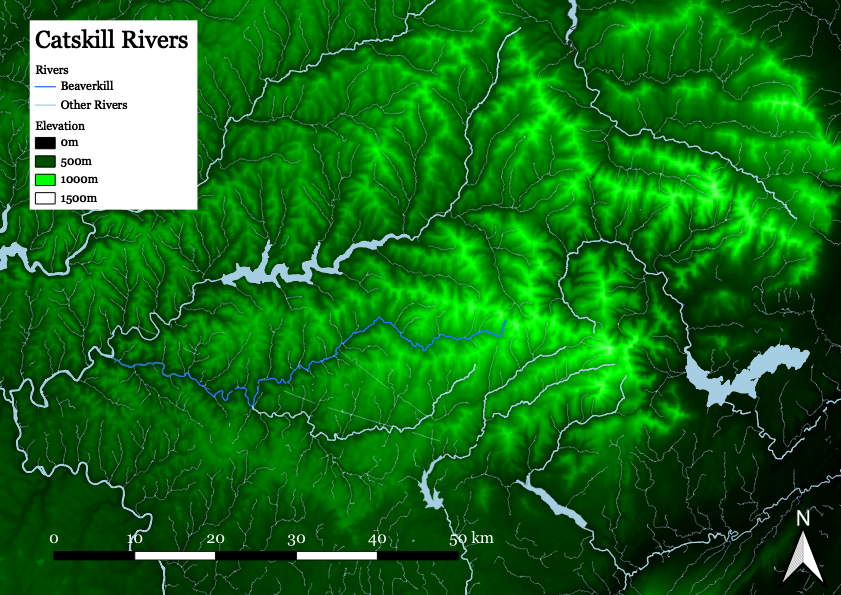
The Beaverkill drains the Catskills to the west, flowing into the East Branch of the Delaware. It rises near the westernmost High Peaks of the Catskills: Doubletop, Graham and Balsam Lake Mountains. From here it descends gradually, for the most part, through a long upland valley. Along side the river,  flat meadows and fields alternate with steep banks. Occasionally, the river passes through a hemlock ravine. Long forested slopes rise on both sides of the narrow valley, with the mountains and hills above decreasing gradually in height to the west. Many mountain streams rush down to join the Beaverkill. A road closely follows the river for most of its length. Below the town of Roscoe, along Route 17, the river forms a steep sided gorge. This impressive feature gradually deepens to about 1200 feet in relief at the junction with the the East Branch of the Delaware River. The Beaverkill is moderately steep, rocky and fast-moving. Occasionally it flows directly on bedrock, but m...

Pennsylvania Anthracite Heritage Museum

On a rainy day in January, you are driving alone on an interstate. Up and down you go through mist covered hills, dark forests and tan, dormant fields. You are listening to a sermon about the fruits of the spiritual life on Christian radio, feeling ambivalent about religion. You come upon a broad valley, filled with cities and towns that look like urban New Jersey. Getting off the interstate, you pass narrow winding highways lined with strip malls, Industrial facilities, piles of scrap metal, and neighborhoods of densely packed, old wood frame houses. A downtown of grey concrete office buildings is visible a few miles away. You drive to a suburban park, and pull up to a cinderblock building like the least inviting public library you have ever seen. Only one other car is in the parking lot, on a Saturday afternoon. This is the Pennsylvania Anthracite Heritage Museum. The valley you are in, home to Scranton / Wilkes-Barre, is the heart of Pennsylvania’s Anthracite Region. The name co...

Schunnemunk Mountain

Image
Schunnemunk Mountain is two parallel ridges of conglomerate bedrock. It is located maybe ten miles west of the Hudson River in Orange County, New York. The ridge tops have some large exposures of glacially scoured bedrock with only dwarf pitch pines growing between the cracks. The views from here of the surrounding country are expansive: the Hudson River and Hudson Highlands to the east, the Schawangunk and Catskill Mountains to the North, rolling terrain of Orange County to the west, and the rugged areas of Harriman and Sterling Forest State Parks to the south. The shape of the two parallel ridges is also cool. The inward facing sides have steep ledges and talus slopes above a long, narrow, moist, flat, deep-soiled inner valley. Tulip poplar, yellow birch, sugar maple, and various oaks attain good size down in there. Little streams drain either end of this valley, and there is a swamp at the northern end. The mountain has a distinctive wedge shape on a map. The northeastern slope is...

Great Grandparents at Rockaway Beach

Image
There is a photo of my great grandparents, Sam Topal and Rhea Gallay, sitting in a hole in the sand on Rockaway Beach. They look like they are maybe 25 years old. Sam's arm is around Rhea but his brow is furrowed with what seems like worry. Rhea looks at ease and happy. What was on the minds of these children of immigrants in working class Jewish Brooklyn? My grandma told me her father Sam had a difficult family life, and career difficulties too. Rhea had very close, loving parents, who my grandma remembers helped raise her, and she describes as the center of family life. Rhea was known for her warmth and caring. My only memory of her is her laughing as my cousin crab walked across her living room in her Brighton Beach apartment, as part of a game of charades. Nevertheless, her life cannot have been all easy. I would like these young New Yorkers, trying to make a life together, to know across the generations that whatever they're worried about, whatever they struggle with...