Posts

Catskill Escarpment

Image
The Catskill Escarpment rises behind the historic stone buildings and hotels of the Hudson Valley. Looking west from the Howard Johnson outside of Saugerties Many of the places I hiked during my youth have come to seem small to me. The Catskill Escarpment on the other hand still provides a challenge, and a thrill, in its slightly depressing Upstate New York way. I first glimpsed it from across the Hudson as a child, riding along the Taconic Parkway, at dusk. A fading glow in the western sky behind it accented the ridge line, a massive landform that dwarfed the scattered human-made lights in the valley in front of it.  The sense of unqualified awe that I felt has diminished some since I've had the privilege of comparing the Catskills with the Rocky Mountains and the Andes, but the escarpment still has the capacity for adult-sized adventure. Running down its edge on a steep trail, the Hudson Valley directly below you, and watching the low horizon across the river rise rapidly in your...

On Composing

Composing music has given me one of the greatest pleasures I’ve known. Not the writing itself, but the listening to people playing it, or more specifically knowing that something I wrote has affected the listeners, I’ve found to be an intense and almost unseemly feeling of aggrandizement. Many people have had the fun moment of telling a joke to a room full of people and having them laugh heartily. Hearing one’s own music performed is like this but moreso. A composer can really put a lot of themselves into a piece of music, and ideally can tap into some realm of abstract beauty, and to have those depths dredged up from one’s own self to be recognized by others is a more serious thrill than any joke or funny story I can think of. There are many different ways musicians like myself enjoy making music, and the the joy that I find in all of them seems related, but only distantly so. To play live, improvisational or quasi-improvizational music and watch people dance to it is great, but in so...

Kelly's Run, Lancaster County, PA

Image
 Much of eastern North America consists of landforms characterized by steep sides and flat or rolling tops. The Allegheny Plateau is a particualrly large-scale example: a whole ocean's worth of seafloor sediments uplifted, but still mostly flat, and now dissected by streams. Even in our biggest Eastern mountains from Blue Ridge to the White Mountains, the steepest and most mountainous terrain is on the sides, more recent erosional surfaces, while closer to the top becomes broader and flatter. A hiker can climb steeply past cliffs and waterfalls only to reach hotels and campgrounds at the higher elevations. A huge but subtle instance is the Piedmont. Hardly mountainous at all, it is underlain by metamorphic rock formed during mountain building at an earlier era of the earth's history. Although worn down, the bedrock is still erosion-resistant. The border between the coastal plain and the Piedmont is marked by the "fall-line" of industrial water power fame. Looking at a...

Hudson Highlands: a personal note

Image
The Highlands region of New Jersey and New York becomes sharply defined along its northwestern boundary, where slopes descend to the the sedimentary basin that supports the cities of Newburgh and Beacon, apple orchards, and sprawl. Glacially scoured, bare bedrocks hilltops along the Highlands' northwestern edge have great views of the Hudson Valley, the Shawangunk Mountains and the Catskills beyond. Public hiking access to such spots includes the Appalachian Trail through Dutchess County, Hudson Highlands State Park, Storm King State Park and Black Rock Forest. This view as I've seen it at different points in my life has had many meanings for me. Starting to explore the Highlands region as a kid with my dad, from our home well to the south in the Piedmont of NJ, it was a look beyond the limits of the world we could reach -- the radius of an hour or two of driving. For many years in my 20s as I've tried to set out on my own, these mountains were the objects of my desire for ...

Beaverkill Valley

Image
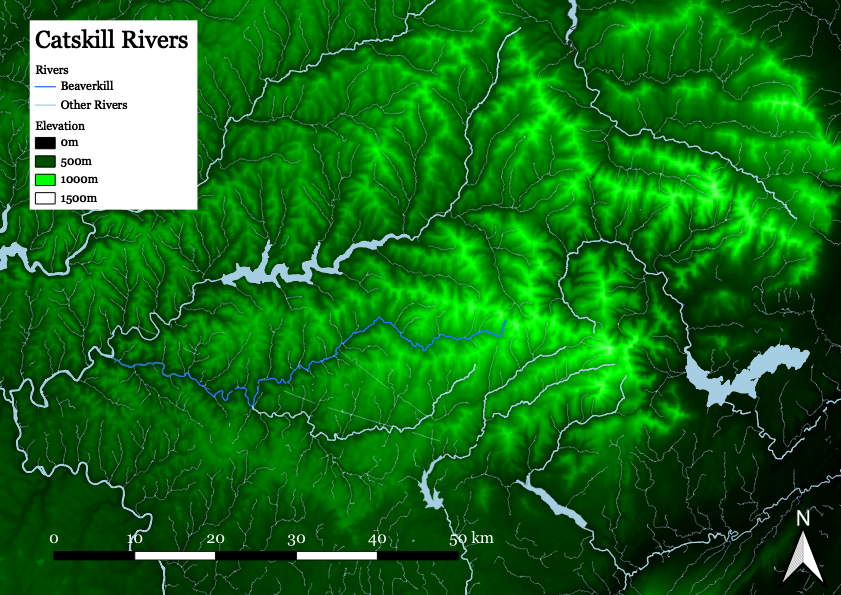
The Beaverkill drains the Catskills to the west, flowing into the East Branch of the Delaware. It rises near the westernmost High Peaks of the Catskills: Doubletop, Graham and Balsam Lake Mountains. From here it descends gradually, for the most part, through a long upland valley. Along side the river,  flat meadows and fields alternate with steep banks. Occasionally, the river passes through a hemlock ravine. Long forested slopes rise on both sides of the narrow valley, with the mountains and hills above decreasing gradually in height to the west. Many mountain streams rush down to join the Beaverkill. A road closely follows the river for most of its length. Below the town of Roscoe, along Route 17, the river forms a steep sided gorge. This impressive feature gradually deepens to about 1200 feet in relief at the junction with the the East Branch of the Delaware River. The Beaverkill is moderately steep, rocky and fast-moving. Occasionally it flows directly on bedrock, but m...

Pennsylvania Anthracite Heritage Museum

On a rainy day in January, you are driving alone on an interstate. Up and down you go through mist covered hills, dark forests and tan, dormant fields. You are listening to a sermon about the fruits of the spiritual life on Christian radio, feeling ambivalent about religion. You come upon a broad valley, filled with cities and towns that look like urban New Jersey. Getting off the interstate, you pass narrow winding highways lined with strip malls, Industrial facilities, piles of scrap metal, and neighborhoods of densely packed, old wood frame houses. A downtown of grey concrete office buildings is visible a few miles away. You drive to a suburban park, and pull up to a cinderblock building like the least inviting public library you have ever seen. Only one other car is in the parking lot, on a Saturday afternoon. This is the Pennsylvania Anthracite Heritage Museum. The valley you are in, home to Scranton / Wilkes-Barre, is the heart of Pennsylvania’s Anthracite Region. The name co...

Schunnemunk Mountain

Image
Schunnemunk Mountain is two parallel ridges of conglomerate bedrock. It is located maybe ten miles west of the Hudson River in Orange County, New York. The ridge tops have some large exposures of glacially scoured bedrock with only dwarf pitch pines growing between the cracks. The views from here of the surrounding country are expansive: the Hudson River and Hudson Highlands to the east, the Schawangunk and Catskill Mountains to the North, rolling terrain of Orange County to the west, and the rugged areas of Harriman and Sterling Forest State Parks to the south. The shape of the two parallel ridges is also cool. The inward facing sides have steep ledges and talus slopes above a long, narrow, moist, flat, deep-soiled inner valley. Tulip poplar, yellow birch, sugar maple, and various oaks attain good size down in there. Little streams drain either end of this valley, and there is a swamp at the northern end. The mountain has a distinctive wedge shape on a map. The northeastern slope is...